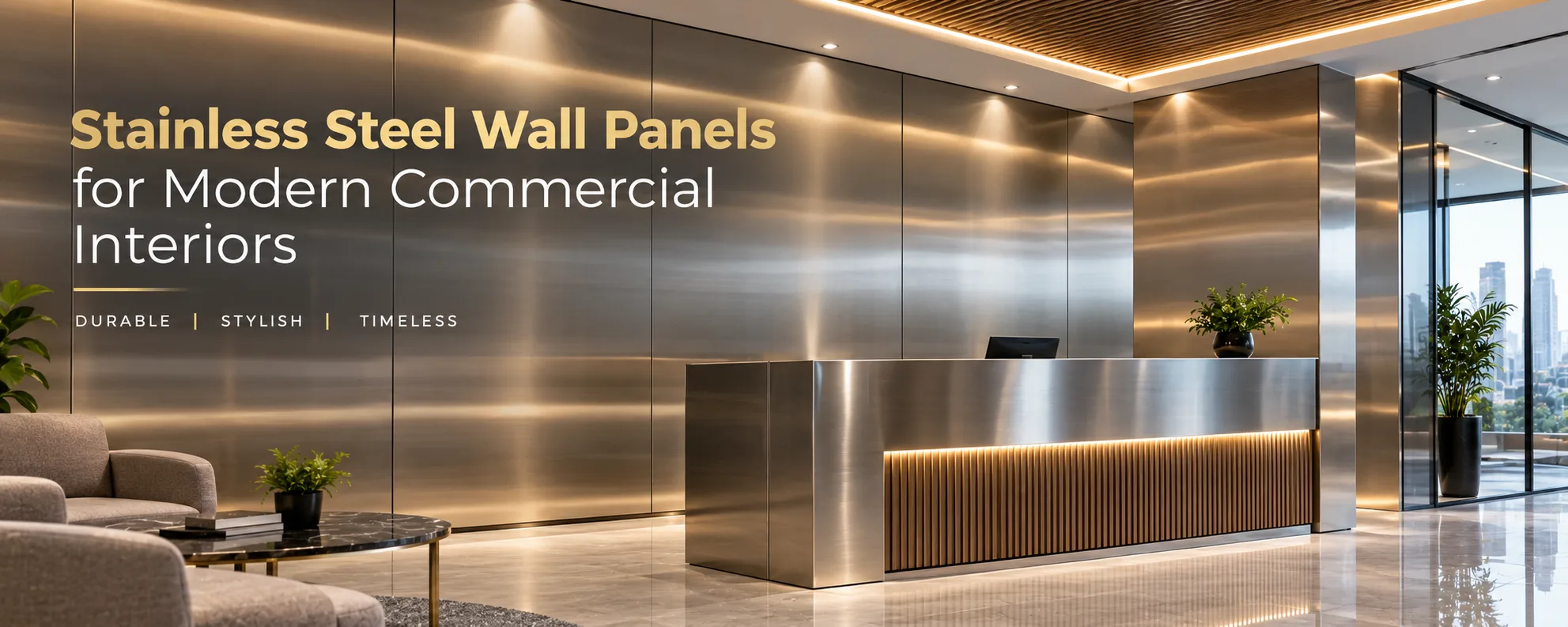
Modern commercial interiors are increasingly moving beyond conventional wall finishes. Architects and interior designers are using metallic surfaces, textured materials and architectural finishes to create spaces that are visually distinctive while meeting practical project requirements.
Among these materials, stainless steel wall panels offer a combination of contemporary aesthetics, finish flexibility and suitability for a wide range of commercial applications.
From corporate reception areas and hotel lobbies to retail stores, elevator lobbies and feature walls, stainless steel can be specified in different finishes, colours, textures and patterns to complement the overall design concept.
The right selection, however, involves more than choosing a visually attractive sheet. Factors such as application, lighting, traffic, finish, panel dimensions, fabrication, installation and maintenance should all be considered.
This guide explains how architects, designers, contractors and commercial project owners can evaluate stainless steel wall panels for modern interior projects.
What Are Stainless Steel Wall Panels?
Stainless steel wall panels are architectural wall surfaces made using stainless steel sheets that are cut, fabricated, formed or installed as panels on interior walls.
While stainless steel sheets are the basic material, wall panels represent the fabricated or installed architectural application of those sheets.
Depending on the project, sheets may be:
- Cut to specified dimensions
- Fabricated into panels
- Formed around architectural elements
- Installed over suitable substrates
- Combined with other materials
- Used as flat or decorative wall surfaces
- Finished with different textures, colours or patterns
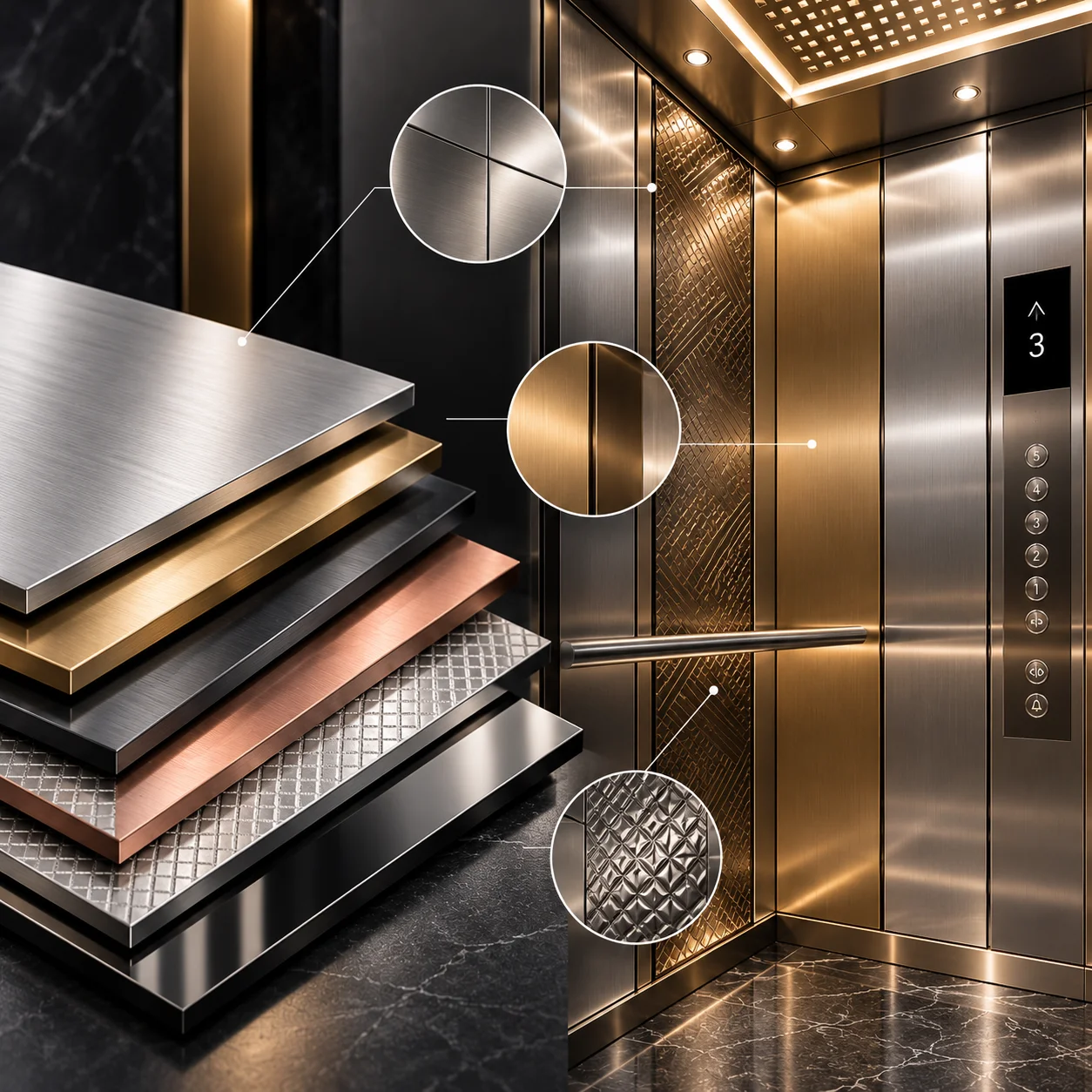
The surface finish plays a major role in determining the final appearance.
Common stainless steel finishes include:
- Hairline – subtle directional grain
- Mirror – highly reflective appearance
- Matt – softer, understated visual character
- PVD – coloured metallic appearance
- Etched – decorative patterns and surface designs
- Embossed – textured or three-dimensional visual effect
This range makes stainless steel suitable for both understated architectural interiors and highly decorative commercial spaces.
Why Use Stainless Steel Wall Panels in Commercial Interiors?
The choice of a wall material should balance appearance with the practical requirements of the project. Stainless steel can offer several advantages when appropriately specified and installed.
Modern and Premium Appearance
Metallic surfaces can immediately introduce a contemporary architectural character to an interior.
Depending on the finish, stainless steel can appear:
- Minimalist
- Industrial
- Sophisticated
- Luxurious
- Contemporary
- Decorative
A hairline surface can create a subtle architectural look, while mirror or PVD finishes can create a stronger visual statement.
The finish therefore becomes part of the design language rather than simply being a protective wall surface.
Multiple Design Options
One of the biggest advantages of decorative stainless steel is the variety of surface treatments available.
Architects and designers can explore differences in:
- Texture
- Reflectivity
- Colour
- Pattern
- Grain direction
- Surface appearance
- Metallic effect
For example, a project may use hairline stainless steel for broad wall surfaces and PVD or mirror stainless steel as an accent.
This flexibility can help designers create a coordinated material palette across different areas of a commercial building.
Suitable for High-Traffic Spaces
Commercial environments often experience significantly more movement and interaction than residential interiors.
Reception areas, lift lobbies, corridors, retail spaces and hospitality environments may require wall surfaces that can be incorporated into a long-term maintenance strategy.
Stainless steel can be considered for these environments based on the specific grade, finish, fabrication, installation conditions and expected use.
The material should still be selected according to the requirements of the particular project rather than assuming that every stainless steel finish will perform identically.
Easy Integration With Other Materials
Stainless steel does not have to dominate the entire interior.
It can be combined with materials such as:
- Wood
- Glass
- Marble
- Stone
- Tiles
- Laminates
- Painted surfaces
- Architectural lighting
For example, a corporate reception could combine hairline stainless steel + wood + illuminated branding, while a luxury hotel lobby could use PVD stainless steel + marble + warm lighting.
This ability to work alongside other materials makes stainless steel useful within layered commercial interior designs.
Long-Term Value
The value of a wall finish should be evaluated beyond its initial purchase price.
Architects and project owners should consider:
Material cost + fabrication + installation + maintenance + expected service requirements
A visually attractive material may not be the right choice if its finish, cleaning requirements or installation system are unsuitable for the intended environment.
The objective should be to select a wall panel solution that balances design intent, performance requirements and lifecycle considerations.
Popular Stainless Steel Finishes for Wall Panels
The finish can completely change how stainless steel appears within an interior.
Finish | Visual Character | Suitable Applications |
Hairline | Subtle linear texture | Offices, elevators, corridors |
Mirror | Highly reflective | Luxury lobbies, feature walls |
Matt | Soft, understated | Modern offices, minimalist interiors |
PVD | Coloured metallic appearance | Hotels, retail, premium interiors |
Etched | Decorative patterns | Feature walls, branded spaces |
Embossed | Textured / 3D appearance | Statement walls, architectural features |
The most appropriate finish depends on the project’s lighting, surrounding materials, desired level of reflection and maintenance expectations.
Where Can Stainless Steel Wall Panels Be Used?
The versatility of decorative stainless steel makes it suitable for a wide range of commercial interior applications.
Offices
In corporate environments, stainless steel wall panels can be used for:
- Reception areas
- Lift lobbies
- Corridors
- Feature walls
- Meeting spaces
- Branding zones
Hairline or matt finishes can complement contemporary office interiors without creating excessive reflection.
Hotels
Hospitality environments often place strong emphasis on visual presentation.
Stainless steel can be incorporated into:
- Hotel lobbies
- Reception areas
- Lift lobbies
- Decorative walls
- Feature elements
- Reception counters
PVD, mirror, etched and other decorative finishes can be considered where a more luxurious appearance is required.
Retail Stores
Retail environments are designed to attract attention and reinforce brand identity.
Stainless steel wall panels can be used for:
- Brand walls
- Display backgrounds
- Entrance features
- Product presentation zones
- Decorative panels
Coloured PVD surfaces can be particularly useful when the metallic finish needs to coordinate with a specific interior colour palette.
Restaurants
Restaurants can use stainless steel as part of both contemporary and premium interior concepts.
Possible applications include:
- Entrance walls
- Feature walls
- Bar areas
- Decorative panels
- Branding zones
- Architectural accents
The selected finish should complement the restaurant’s lighting, furniture, flooring and overall material palette.
Shopping Malls
Large commercial developments can incorporate stainless steel panels into:
- Common areas
- Lift lobbies
- Entrance zones
- Feature walls
- Architectural accents
- Directional or branding areas
The finish can be selected according to the visual character of the particular zone.
Corporate Buildings
Corporate interiors can use stainless steel panels in:
- Main reception areas
- Conference spaces
- Elevator lobbies
- Executive areas
- Feature walls
- Branding installations
Hairline and matt finishes can create a professional architectural appearance, while mirror or PVD finishes can be used selectively for stronger visual impact.
PVD Stainless Steel Wall Panels for Premium Interiors
PVD stainless steel wall panels are an important option for designers looking for coloured metallic surfaces.
PVD stands for Physical Vapor Deposition, a surface treatment process used to create a decorative coating on the stainless steel surface.
Unlike simply painting a metal surface, PVD creates a distinct coloured and metallic visual effect while retaining the underlying stainless steel material.
Depending on the product range and specification, PVD finishes can be available in colours such as:
- Gold
- Rose Gold
- Champagne
- Bronze
- Black
Specific colours, shades and surface treatments should be confirmed for the selected product.
Why Is PVD Popular in Premium Interiors?
PVD can give designers greater freedom to coordinate stainless steel with the overall interior palette.
For example:
Gold PVD + marble + warm lighting
can create a luxury hospitality aesthetic.
Similarly:
Black PVD + glass + accent lighting
can create a contemporary retail environment.
PVD can therefore be used not only as a wall material but as an important component of the project’s overall visual identity.
How to Choose the Right Stainless Steel Wall Panel
Choosing a wall panel should begin with the project requirements rather than the finish catalogue.
Use the following checklist before finalizing your specification.
1. Interior Style
Is the project:
- Minimalist?
- Luxury?
- Contemporary?
- Industrial?
- Corporate?
- Decorative?
The finish should support the intended design language.
2. Project Location
Consider where the panel will be installed.
A hotel lobby, elevator lobby, office corridor and retail feature wall may have different requirements.
3. Traffic Level
Consider the amount of movement and human interaction around the surface.
High-traffic environments may require careful consideration of finish, cleaning and surface presentation.
4. Lighting
Lighting can significantly influence how stainless steel looks.
Consider:
- Natural light
- Spotlights
- LED strips
- Recessed lighting
- Warm lighting
- Cool lighting
Mirror surfaces, in particular, can produce strong reflections.
5. Desired Reflection
Ask whether the project requires:
Controlled reflection → Hairline / Matt
or
Strong reflection → Mirror
The desired level of reflectivity should be part of the initial design discussion.
6. Colour Scheme
If the project requires a specific metallic colour, PVD finishes may provide additional design possibilities.
The final colour should be evaluated using physical samples wherever possible.
7. Panel Size
Panel dimensions should be coordinated with:
- Wall dimensions
- Joint locations
- Access requirements
- Fabrication capabilities
- Transportation
- Installation method
Large-format panels can create a cleaner visual appearance but may introduce additional fabrication and handling considerations.
8. Surface Pattern
For decorative interiors, determine whether the project requires:
- Plain finish
- Linear texture
- Etching
- Embossing
- Coloured surface
- Custom decorative pattern
9. Maintenance Requirements
Consider how often the surface will be cleaned and how visible fingerprints, dust or marks may be under the project’s lighting.
Different finishes can have different visual maintenance requirements.
10. Budget and Lifecycle Value
The decision should consider more than material price.
Evaluate:
- Material
- Fabrication
- Installation
- Cleaning
- Maintenance
- Expected service requirements
- Replacement or repair considerations
Stainless Steel Wall Panels vs Other Wall Finishes
Stainless steel is one option among many architectural wall materials. The best choice depends on the project.
Material | Design Flexibility | Maintenance Considerations | Visual Character | Typical Applications |
Stainless Steel | High | Depends on finish and environment | Modern / metallic | Commercial interiors |
Wood Panels | High | Requires finish-specific care | Warm / natural | Offices, hospitality |
Marble | Moderate to high | Requires material-specific care | Luxury / natural | Hotels, reception areas |
Glass | High | Fingerprints can be visible | Clean / contemporary | Offices, retail |
Ceramic Tiles | High | Generally practical | Varied | Commercial and hospitality |
Laminates | High | Depends on product | Versatile | Offices, retail |
Decorative Metal | High | Depends on material and finish | Contemporary | Feature walls |
Rather than asking whether stainless steel is universally better, project teams should ask:
Which material best meets the project’s aesthetic, functional and lifecycle requirements?
Design Ideas for Modern Commercial Interiors
Stainless steel becomes particularly effective when combined thoughtfully with other materials.
Minimalist Office
Hairline stainless steel + wood + neutral walls
The subtle linear finish adds a metallic architectural element without overwhelming the minimalist design.
Luxury Hotel Lobby
Gold PVD + marble + warm lighting
A coloured metallic finish can complement natural stone and warm architectural lighting to create a premium hospitality environment.
Modern Retail Store
Black PVD + glass + accent lighting
Dark metallic surfaces can create contrast against glass and focused lighting, supporting a contemporary retail aesthetic.
Corporate Reception
Hairline or matt finish + wood + illuminated branding
This combination can create a professional reception environment while allowing the company’s branding to remain the visual focus.
Elevator Lobby
Mirror + hairline combination
Using mirror as a feature and hairline as a surrounding finish can create contrast while controlling the amount of reflection across the space.
Installation and Fabrication Considerations
A high-quality stainless steel sheet does not automatically guarantee a high-quality wall installation.
Fabrication and installation can significantly influence the final appearance.
Before installation, project teams should consider:
Accurate Measurements
Wall dimensions should be verified before fabrication to reduce alignment and fitting issues.
Substrate Condition
The underlying wall or substrate should be appropriately prepared for the selected fixing method.
Panel Dimensions
Panel sizes should be coordinated with transportation, fabrication and installation requirements.
Joint Alignment
Consistent joints can have a major effect on the appearance of large wall surfaces.
Edge Finishing
Exposed edges, corners and transitions should be detailed during the design stage.
Fixing System
The appropriate fixing or installation method should be determined according to the substrate, panel design and project requirements.
Grain Direction
For directional finishes such as hairline, grain direction needs to be specified and maintained consistently.
Protection During Installation
Finished stainless steel surfaces should be adequately protected during subsequent construction activities to reduce the risk of damage or contamination.
Electrical and Lighting Coordination
Wall panels should be coordinated with:
- Lighting
- Electrical outlets
- Switches
- Signage
- Digital displays
- Other architectural elements
Early coordination can reduce the need for modifications after fabrication.
Maintenance of Stainless Steel Wall Panels
Stainless steel wall panels are not necessarily maintenance-free. Their maintenance requirements depend on the finish, environment, level of contact and cleaning practices.
A practical maintenance approach includes:
Routine Cleaning
Remove dust and surface contamination regularly using appropriate cleaning methods.
Use Suitable Cleaning Products
Cleaning products should be compatible with the stainless steel surface and its specific finish.
Avoid Abrasive Materials
Harsh abrasive materials can affect the appearance of decorative surfaces.
Manage Fingerprints
Highly reflective finishes such as mirror may make fingerprints and smudges more visible, particularly under direct lighting.
Follow Grain Direction
For directional finishes such as hairline, cleaning should generally follow the direction of the grain.
Consider the Environment
Commercial spaces with higher traffic or frequent contact may require more regular cleaning than decorative surfaces in low-contact areas.
The manufacturer’s recommended care instructions should be followed for the specific stainless steel product.
Why Choose Inox Steeluxe for Stainless Steel Wall Panels?
For commercial interior projects, the ability to choose from multiple decorative surface treatments can help architects and designers develop a more coordinated material strategy.
Inox Steeluxe offers stainless steel solutions across a range of decorative finishes and architectural applications.
Relevant options include:
- Designer stainless steel sheets
- PVD stainless steel sheets
- Hairline finishes
- Mirror finishes
- Matt finishes
- Etched finishes
- Embossed finishes
- Elevator interior solutions
- Custom decorative applications
This range can support different design requirements, from subtle architectural wall surfaces to premium feature installations.
For architects, interior designers, contractors, builders and fabricators, the selection process should consider finish, application, lighting, panel dimensions, fabrication, installation and maintenance requirements.
The objective is not simply to select an attractive stainless steel sheet, but to specify a surface solution that works within the complete architectural design.
Frequently Asked Questions
Yes. Stainless steel wall panels can be used across various commercial environments, including offices, hotels, retail stores, restaurants, shopping malls and corporate buildings. The appropriate grade, finish, fabrication and installation method should be selected according to the project requirements.
There is no single best finish for every project. Hairline, mirror, matt, PVD, etched and embossed finishes can serve different design purposes. The right choice depends on the desired appearance, lighting, traffic, reflection and maintenance requirements.
PVD stainless steel can be considered for hotel, office, retail and other premium interiors where a coloured metallic appearance is desired. Specific colours and finishes should be confirmed according to the selected product range.
Decorative stainless steel sheets can be specified and fabricated according to project requirements, subject to the capabilities of the manufacturer, fabricator and installation system. Custom dimensions, finishes, patterns and combinations may be possible depending on the product.
Stainless steel can be practical to maintain when the appropriate finish and cleaning methods are selected. However, maintenance requirements vary depending on the surface finish, environment, traffic and cleaning practices.
Yes. Stainless steel works well as part of a mixed-material interior. Designers can combine stainless steel with marble, wood, glass, stone, tiles and other materials to create contrast and visual hierarchy.
A stainless steel sheet is the base material, while a wall panel is an architectural application in which stainless steel sheets are cut, fabricated, finished and installed as part of a wall system.
They can be considered for many high-traffic commercial environments, but the appropriate finish, grade, fabrication and installation method should be evaluated according to the specific application and expected use.
Conclusion
Stainless steel wall panels offer architects, interior designers and commercial project teams a flexible way to introduce contemporary metallic surfaces into modern interiors.
From subtle hairline and matt finishes to highly reflective mirror surfaces and coloured PVD stainless steel, the range of decorative treatments allows designers to create very different architectural experiences using the same core material.
The best specification should consider:
Design → Application → Finish → Lighting → Traffic → Fabrication → Installation → Maintenance
Whether the project is an office, hotel, retail store, restaurant, shopping mall or corporate building, stainless steel can be integrated as a complete wall surface, feature element or part of a mixed-material interior.
For architects, designers, contractors and builders exploring decorative stainless steel for commercial interiors, Inox Steeluxe provides a range of finish and design possibilities to support different architectural requirements.