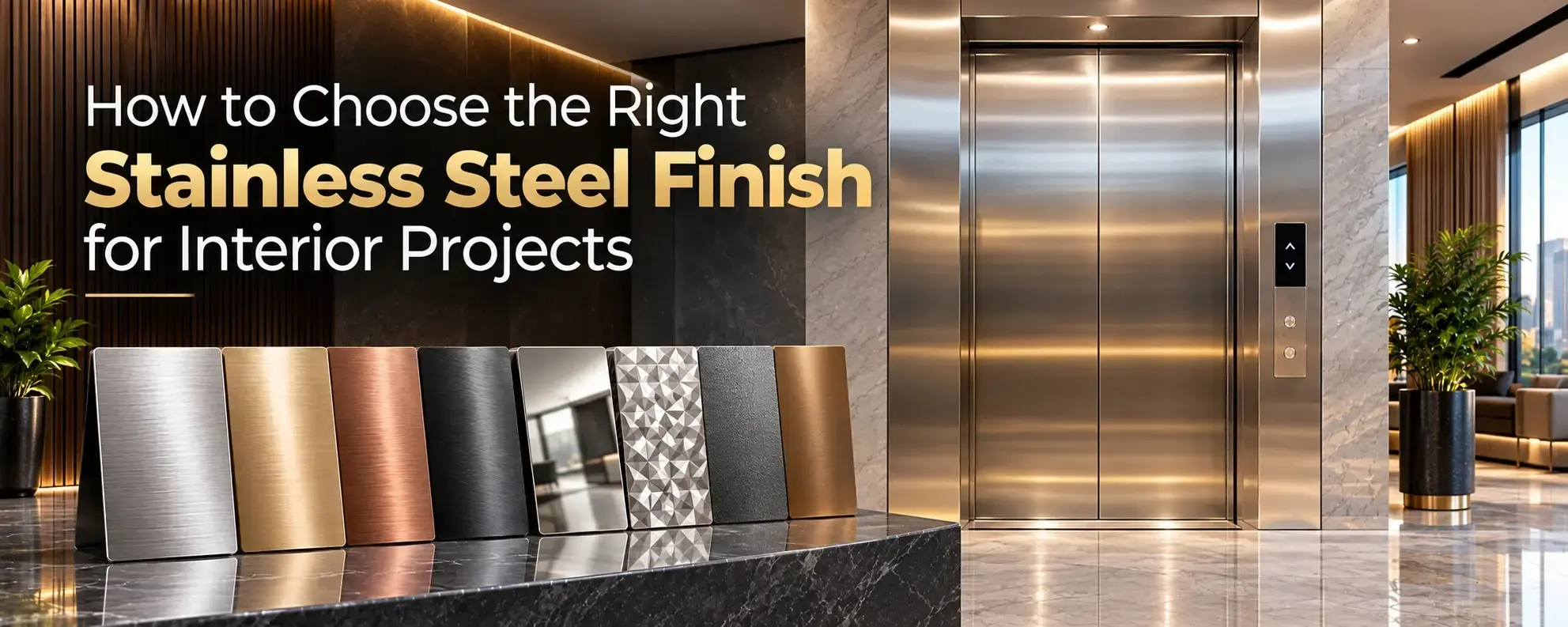
Stainless steel has become an important design material in modern interior architecture. From elevator cabins and hotel lobbies to feature walls, reception areas, retail spaces and luxury residences, stainless steel can provide durability while creating a distinctive visual character.
But stainless steel is not limited to one appearance.
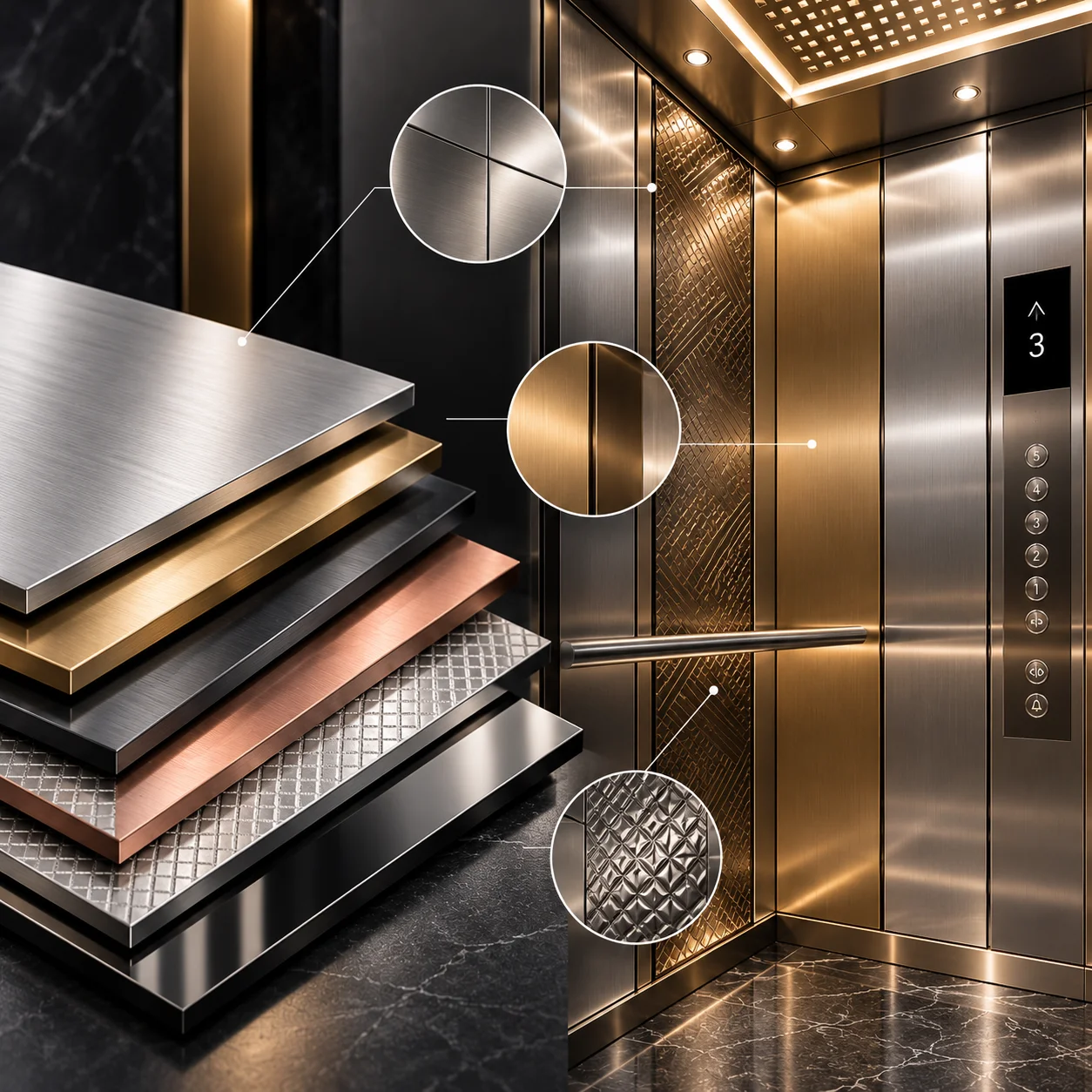
The same stainless steel base material can look completely different depending on its surface finish, texture, colour, reflectivity and decorative treatment. A highly reflective mirror surface creates a very different atmosphere from a subtle hairline finish, while a PVD-coated surface can introduce metallic colours such as gold, bronze, black or champagne.
For architects, interior designers, builders and fabricators, selecting the right stainless steel finish for interior projects therefore requires more than choosing the finish that looks attractive in a catalogue.
The application, lighting, traffic, maintenance requirements, design style, fabrication and overall project specifications should all be considered.
This guide explains the most popular stainless steel finishes and how to select the right option for different interior applications.
What Is a Stainless Steel Finish?
A stainless steel finish refers to the surface appearance and texture created through processes such as polishing, brushing, grinding, texturing, etching or decorative coating.
The finish can influence:
- Surface reflection
- Texture
- Visual depth
- Colour
- Grain direction
- Gloss level
- Fingerprint visibility
- Overall design character
It is important to distinguish between stainless steel grade, thickness and surface finish.
For example, two stainless steel sheets can have the same grade and thickness but look significantly different because they have different surface finishes.
Grade
The grade relates to the composition and properties of the stainless steel.
Thickness
Thickness refers to the physical thickness of the sheet or plate and can influence fabrication and structural requirements.
Surface Finish
The finish determines how the surface looks and feels.
For an interior project, the finish should therefore be treated as part of the overall design specification rather than as an afterthought.
Popular Stainless Steel Finishes for Interior Projects
Different finishes can create different visual effects and can be appropriate for different applications.
Hairline Finish
A hairline finish features a fine, directional grain running consistently across the stainless steel surface.
It offers a refined and contemporary appearance without the strong reflection of a mirror surface.
Key characteristics
- Fine linear grain
- Subtle visual texture
- Lower glare than mirror
- Contemporary appearance
- Directional visual movement
Hairline stainless steel is commonly considered for:
- Elevator interiors
- Office interiors
- Commercial spaces
- Wall panels
- Doors and partitions
- Modern architectural interiors
It can be particularly useful in areas where designers want stainless steel to remain visually sophisticated without becoming the dominant reflective element.
Mirror Finish
Mirror stainless steel has a highly polished and reflective surface.
It can create a strong visual impact and is often associated with premium and luxury interiors.
Key characteristics
- High reflectivity
- Smooth appearance
- Strong visual impact
- Bright and luxurious character
- Ability to visually expand certain spaces
Mirror finishes can be considered for:
- Luxury hotel interiors
- Elevator cabins
- Feature walls
- Reception areas
- Premium retail interiors
- Decorative architectural elements
However, highly reflective surfaces can make fingerprints, smudges and scratches more visually noticeable.
This makes the location and expected level of handling important considerations when specifying a mirror finish.
Matt Finish
A matt finish provides a softer and more understated appearance with reduced reflection.
It can work particularly well in contemporary and minimalist interiors where designers want the metallic character of stainless steel without a highly polished appearance.
Key characteristics
- Soft appearance
- Low reflection
- Contemporary look
- Minimal visual glare
- Understated metallic character
Matt stainless steel can be considered for:
- Offices
- Minimalist interiors
- Wall panels
- Partitions
- Commercial spaces
- Contemporary architectural applications
PVD Finish
PVD, or Physical Vapour Deposition, is a coating process that can create decorative metallic colours and visual effects on stainless steel.
Common PVD colours include:
- Gold
- Rose Gold
- Black
- Bronze
- Champagne
One important point for designers is that PVD colour should not be considered separately from the base surface finish.
The final visual result depends on the combination of the underlying stainless steel surface and the PVD coating.
For example, a PVD coating over a highly polished surface can produce a very different appearance from the same colour applied over a brushed or textured surface.
PVD stainless steel can therefore be useful for:
- Luxury hotels
- Retail stores
- Premium offices
- Elevator interiors
- Reception areas
- Feature walls
- Decorative partitions
Etched Finish
Etched stainless steel uses controlled surface treatment to create patterns, textures or decorative designs.
It gives architects and interior designers greater freedom to create customised visual elements.
Etched finishes can be considered for:
- Feature walls
- Decorative panels
- Elevator interiors
- Hotel interiors
- Retail spaces
- Branded environments
Custom patterns can also help integrate architectural branding or artistic elements into the interior.
Embossed Finish
Embossed stainless steel creates a three-dimensional or textured surface.
Instead of relying only on colour or reflection, the finish introduces physical depth and texture.
It can be suitable for:
- Feature surfaces
- Designer wall panels
- Decorative installations
- Hospitality interiors
- Retail interiors
- Statement architectural elements
Embossed finishes can be especially effective when combined with directional or accent lighting.
How to Choose the Right Stainless Steel Finish
There is no single best stainless steel finish for every interior project.
The correct choice depends on the environment and the design objective.
A practical approach is:
Application → Finish → Lighting → Maintenance → Sample → Final Specification
Consider the Interior Application
Start by identifying where the stainless steel will be used.
Application
Suitable Starting Options
Elevator Interiors
Hairline, Mirror, PVD, Etched
Feature Walls
Mirror, PVD, Etched, Embossed
Hotel Interiors
Mirror, PVD, Hairline
Retail Interiors
PVD, Mirror, Etched
Office Interiors
Hairline, Matt, PVD
Decorative Partitions
Etched, Embossed, Hairline
Reception Areas
Mirror, PVD, Etched
These are starting points rather than fixed specifications.
The final selection should consider the project’s lighting, traffic, cleaning requirements, surrounding materials and fabrication details.
Consider the Lighting
Lighting can dramatically change the appearance of stainless steel.
This is particularly important when working with large wall surfaces, elevator interiors or decorative feature panels.
Direct Lighting
Direct lighting can create strong reflections on mirror stainless steel.
This can produce a dramatic effect but may also create unwanted glare.
Side Lighting
Light coming from the side can emphasize the texture and grain of hairline, etched or embossed surfaces.
This can make surface patterns more visually prominent.
Soft Lighting
Soft or diffused lighting can enhance the colour and depth of PVD finishes without creating excessive reflection.
Directional Grain
Hairline finishes have a visible directional pattern.
The orientation of the grain should therefore be considered during panel layout and installation.
For large installations, architects and designers should review actual samples under lighting conditions similar to those expected in the completed project.
A finish that looks subtle in a showroom may appear significantly brighter, darker, warmer or more reflective under different lighting conditions.
Consider Maintenance and Traffic
The amount of traffic and human contact should influence finish selection.
High-Traffic Areas
For areas exposed to frequent touching and handling, designers may consider:
- Hairline
- Matt
- Selected PVD finishes
These can make everyday marks less visually prominent than highly reflective surfaces, although actual performance depends on the finish and environment.
Luxury Feature Areas
For areas where visual impact is more important than frequent handling, designers may consider:
- Mirror
- PVD
- Etched
- Embossed finishes
The important point is to balance aesthetics with the practical maintenance requirements of the space.
Consider the Overall Interior Design Style
The stainless steel finish should work with the architectural language of the project.
Modern Minimalist
Consider:
Hairline + Matt
These finishes can provide a refined metallic appearance without overwhelming a clean minimalist design.
Luxury
Consider:
Mirror + Gold PVD + Champagne PVD
These finishes can create a richer and more decorative atmosphere.
Contemporary
Consider:
Black PVD + Bronze PVD + Hairline
These options can complement darker materials, wood, stone and contemporary furniture.
Artistic
Consider:
Etched + Embossed
These finishes can introduce patterns, texture and visual depth.
Premium Hospitality
Consider:
Mirror + PVD + Etched
Hotels and hospitality spaces often benefit from materials that create a memorable visual experience.
Mirror vs Hairline vs Matt vs PVD vs Etched vs Embossed
Finish | Appearance | Visual Impact | Typical Interior Use |
Hairline | Linear and subtle | Medium | Offices, elevators, commercial spaces |
Mirror | Highly reflective | High | Luxury interiors, feature areas |
Matt | Soft and low-glare | Medium | Minimalist interiors |
PVD | Coloured metallic | High | Hotels, retail, premium interiors |
Etched | Patterned and decorative | High | Feature walls, decorative panels |
Embossed | Textured/3D | High | Feature surfaces, designer interiors |
Rather than selecting a finish simply because it looks attractive, compare the finish against the project’s practical requirements.
Don’t Choose a Finish Based on Appearance Alone
A beautiful sample does not automatically make it the right finish for the project.
Before finalizing a stainless steel interior finish, evaluate:
Application
Where will the material be installed?
Traffic Level
Will people frequently touch or interact with the surface?
Lighting
How will natural and artificial light interact with the finish?
Cleaning Requirements
How frequently will the surface need to be cleaned?
Surface Area
Large installations require greater attention to consistency and panel alignment.
Grain Direction
Hairline and other directional finishes should be planned carefully so adjoining panels maintain a consistent visual direction.
Colour Consistency
This is particularly important for decorative and PVD finishes.
Fabrication Requirements
Consider cutting, bending, forming, edge treatment and installation requirements before approving the material.
Installation Method
The installation system can influence panel appearance and alignment.
Project Budget
Premium finishes, custom patterns and decorative treatments can affect project cost.
Why Grain Direction Matters in Large Projects
Grain direction can become an important design consideration when stainless steel sheets are installed across large surfaces.
For example, if adjacent hairline panels are installed with inconsistent grain directions, the difference may become immediately visible under directional lighting.
Architects, designers and fabricators should therefore specify:
- Grain direction
- Panel orientation
- Joint arrangement
- Pattern alignment
- Surface consistency
This becomes especially important for:
- Elevator cabins
- Long feature walls
- Reception counters
- Large decorative panels
- Retail interiors
- Hotel interiors
A well-planned finish should look consistent not only on an individual sheet but also across the completed installation.
Why Samples Matter Before Final Selection
One of the best ways to reduce design surprises is to approve a physical sample before finalizing the material.
A digital image or catalogue photograph cannot always reproduce the exact appearance of a metallic surface.
Check the Sample for:
- Colour
- Reflection
- Texture
- Grain direction
- Surface depth
- Lighting response
- Fingerprint visibility
- Cleaning appearance
- Compatibility with surrounding materials
Test Samples Under Actual Project Lighting
If possible, review the sample under lighting conditions similar to those planned for the final space.
This is particularly important for:
- PVD finishes
- Mirror finishes
- Etched finishes
- Embossed finishes
- Dark decorative finishes
A sample review can help architects, designers and clients make a more confident final selection.
Stainless Steel Finishes for Different Interior Projects
Hotel Lobby
A hotel lobby often needs a material that creates an immediate visual impression.
Possible starting options include:
Mirror + PVD + Etched
These can be combined with stone, wood, glass and architectural lighting.
Elevator Cabin
Elevator interiors experience frequent contact and require careful consideration of appearance and maintenance.
Possible options include:
Hairline + Mirror + PVD + Etched
The final choice depends on the desired aesthetic and traffic level.
Restaurant
Restaurants may use stainless steel as both a decorative and functional design element.
Possible options include:
Matt + Hairline + PVD
Corporate Office
Office interiors generally benefit from clean, understated materials.
Possible options include:
Hairline + Matt + Selected PVD finishes
Retail Showroom
Retail spaces can use decorative stainless steel to create branded and visually distinctive environments.
Possible options include:
PVD + Mirror + Etched
Luxury Residential Interior
For premium residences, stainless steel can be integrated into:
- Lift cabins
- Feature walls
- Partitions
- Furniture details
- Decorative panels
Possible options include:
Mirror + Gold PVD + Champagne PVD + Etched
Reception Area
The reception is often one of the first areas visitors see.
Possible options include:
Mirror + PVD + Etched
Feature Wall
Feature walls provide an opportunity to use stainless steel as a primary design element.
Possible options include:
PVD + Etched + Embossed + Mirror
Why Choose Inox Steeluxe for Decorative Stainless Steel Interiors?
For architects, interior designers, builders and fabricators, material selection is only one part of the process.
Consistency, customization and the ability to translate a design concept into the required stainless steel finish are also important.
Inox Steeluxe offers stainless steel products for architectural and interior applications, including decorative stainless steel sheet and plate solutions.
Its stated offerings include finish categories such as:
- Mirror finish
- Hairline finish
- Matt finish
- PVD finishes
- Etched finishes
- Embossed finishes
- Designer stainless steel sheets
- Elevator interior solutions
Inox Steeluxe states that its stainless steel plates can be customized in dimensions, finishes and decorative treatments according to project requirements.
This type of customization can be particularly useful for projects where the stainless steel finish needs to align with a specific architectural concept.
For a project involving large wall panels, elevator cabins or decorative surfaces, designers can discuss factors such as:
- Required finish
- Sheet dimensions
- Thickness
- Pattern
- Colour
- Grain direction
- Application
- Fabrication requirements
The objective should be to specify the stainless steel solution according to the complete project—not simply choose a finish from a catalogue.
Frequently Asked Questions
There is no single best finish.
Hairline can work well for contemporary and commercial interiors, mirror can create a strong luxury effect, matt can provide a subtle appearance, while PVD, etched and embossed finishes can be used when stronger decorative impact is required.
The right choice depends on application, lighting, traffic, maintenance and design style.
It depends on the desired appearance.
Hairline provides a subtle directional texture and generally lower reflection.
Mirror provides a highly reflective and more dramatic appearance.
For high-touch areas, designers should also consider how fingerprints, smudges and scratches may appear.
Hairline, mirror, PVD and etched finishes can all be considered for elevator interiors.
The selection should take into account passenger traffic, lighting, desired visual character, maintenance and overall interior design.
Hairline describes a directional surface finish with a fine linear appearance.
PVD refers to a coating process that can add decorative colours and metallic effects to the stainless steel surface.
A PVD finish can be combined with different base surface appearances, so the final appearance depends on both the base finish and PVD treatment.
Yes, PVD stainless steel can be considered for a wide range of commercial interior applications, including hotels, retail spaces, offices, reception areas and elevator interiors.
The appropriate finish should be selected according to the expected traffic, lighting, cleaning requirements and design objective.
Maintenance depends on the specific finish, application and environment.
In areas with frequent handling, finishes that make fingerprints and minor marks less visually prominent may be easier to manage aesthetically.
The cleaning and maintenance recommendations provided for the specific finish should always be followed.
Yes. Depending on the manufacturer and product range, stainless steel sheets can be customized in areas such as dimensions, colours, patterns and decorative treatments.
Inox Steeluxe states that its stainless steel plates can be customized in dimensions, finishes and decorative treatments according to project requirements.
Architects should consider:
- Interior style
- Lighting
- Traffic
- Finish consistency
- Grain direction
- Panel dimensions
- Joint arrangement
- Cleaning requirements
- Fabrication
- Physical samples
For large surfaces, approving a physical sample and a clear finish specification before production can help reduce inconsistencies.
C onclusion
Choosing the right stainless steel finish for interior projects is both a design and specification decision.
Mirror, hairline, matt, PVD, etched and embossed finishes can each create a different visual and functional result.
The right selection should begin with the application and then consider:
Application → Finish → Lighting → Maintenance → Sample → Final Specification
For architects, interior designers, builders and fabricators, this approach can help ensure that the selected stainless steel finish works not only in the sample room but also in the completed project.
Whether the requirement is a sophisticated hairline finish for an office, a reflective surface for a luxury elevator, a PVD finish for a hotel lobby or an etched or embossed design for a feature wall, the finish should be evaluated in the context of the entire interior.
For projects requiring decorative stainless steel sheets, PVD stainless steel, mirror, hairline, matt, etched or embossed finishes, Inox Steeluxe can be considered as a material partner for architectural and interior applications.
The best stainless steel finish is ultimately not the one that simply looks impressive on its own.